Sharding
What it is
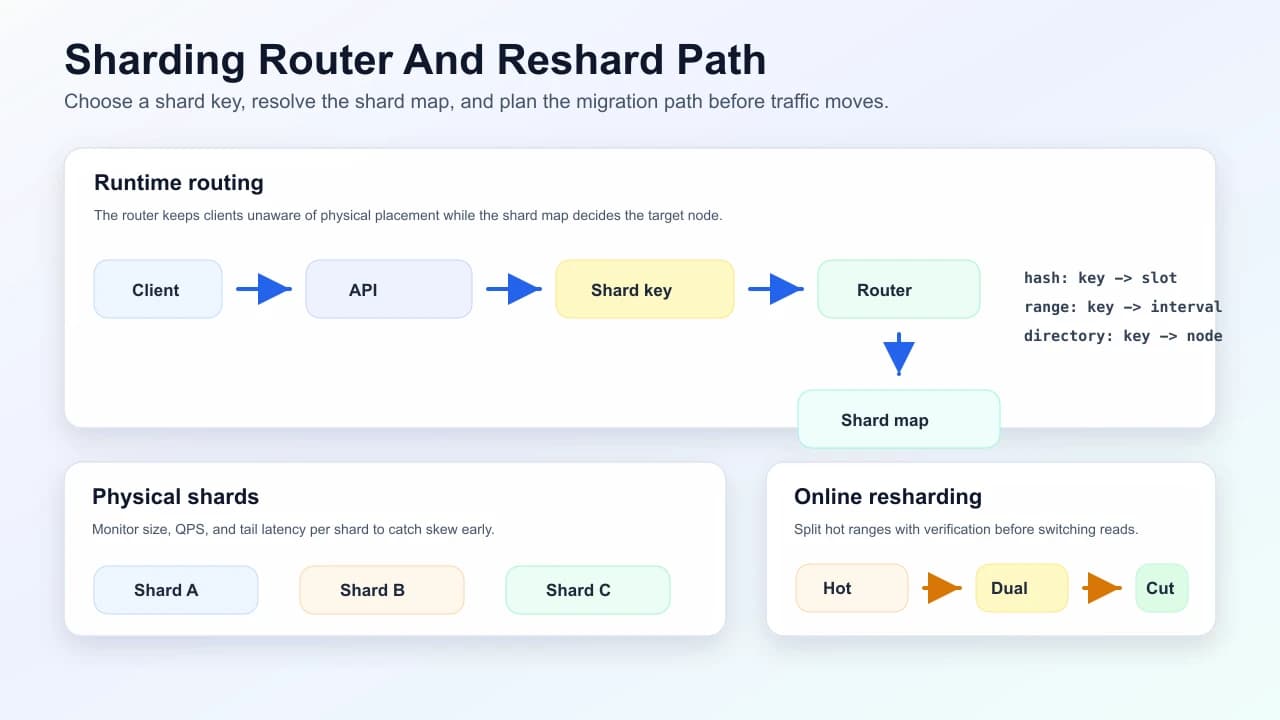
Sharding (horizontal partitioning) splits data across multiple physical nodes so each holds a subset of rows or keys. Clients or middleware route queries to the correct shard using a shard key.
Strategies
- Range sharding: consecutive key ranges per shard (e.g. user ids
0–1Mon shard A). Range scans are easy; hot ranges can overload one shard. - Hash sharding:
hash(shardKey) mod numShardsspreads load more evenly; range queries across shards are harder. - Directory / lookup service: central map from key to shard; flexible resharding at cost of extra hop and component to scale.
  hash(userId) --> shard index --> DB instance
  range(time)  --> time shard    --> (watch hot days)
Concrete example
For a multi-tenant SaaS product, shard by tenantId when most queries stay inside one customer account. A request carries tenantId, the router looks up the shard, and tenant-local reads and writes avoid cross-shard transactions. If a few enterprise tenants become too large, move them to dedicated shards or split their data with a secondary key.
Hot keys
A shard key that is too popular (celebrity user, viral object) puts disproportionate load on one node.
Mitigations:
- Cache at edge (see caching).
- Sub-shard or split hot key into synthetic suffixes with merger in app (advanced).
- Avoid low-cardinality shard keys that collapse traffic.
Resharding
Growing data or skew forces split, merge, or rebalance.
- Double-write / dual read during migration; verify checksums; switch traffic gradually.
- Consistent hashing on ring can reduce full reshuffles when adding nodes (also used by load-balancer algorithms).
- Plan downtime vs online migration; use backlog and rate limits to protect source DB.
Cross-shard queries
Cross-shard joins, global secondary indexes, and global transactions are the real cost of sharding. Prefer access patterns that include the shard key. For global views, use denormalized projections, search indexes, analytics pipelines, or async aggregation instead of making every request scatter-gather across all shards.
When to use
- Single-node DB cannot fit data or QPS after vertical scaling and replication read replicas are insufficient for writes.
- Regulatory data residency (shard by region).
Alternatives
- Partitioned tables inside one managed cluster (BigQuery, Citus-style)—shard-like without you operating shards.
- No sharding: stronger consistency story; simpler ops until you must scale out.
Failure modes
- Cross-shard transactions: expensive or unsupported; design aggregates without global transactions.
- Rebalancing bugs: partial writes, wrong routing table.
- Uneven growth: monitor shard size and QPS per shard.
Common mistakes
- Sharding before vertical scaling, indexes, caching, and read replicas are exhausted.
- Choosing a low-cardinality key like country or status; one value can dominate traffic.
- Forgetting that secondary indexes must either be local to a shard or maintained as a separate global system.
- Updating the shard map without versioning, causing old app instances to route writes incorrectly.
Interview talking points
- Always state shard key choice and hot key plan; use back-of-envelope for growth per shard.
- Link resharding to zero-downtime stories and monitoring.
- Compare to Dynamo-style partitioning in sql-vs-nosql.
Interview answer shape
- First explain why replication or vertical scaling is no longer enough.
- Pick a shard key based on the dominant read/write path and cardinality.
- Explain routing: client, API, router, or directory service, plus shard-map caching.
- Handle painful cases: hot keys, cross-shard queries, global IDs, and resharding.
- Define operations: per-shard QPS, size, lag, error rate, tail latency, and migration checksums.
Common follow-ups: range vs hash sharding, consistent hashing, online resharding, global uniqueness, and how to query without the shard key.
Related fundamentals
- Back-of-the-envelope estimation
- Latency and throughput — per-shard QPS and tail latency under skew
Mark this page when you finish learning it.
Last updated on
Spotted something unclear or wrong on this page?