Reverse Proxy vs CDN
What it is
- Reverse proxy (e.g. nginx, Envoy, HAProxy in front of origins): a server that accepts client connections on behalf of backend apps, often terminating TLS, enforcing limits, and caching responses at the edge of your stack.
- CDN (Content Delivery Network): a globally distributed set of edge PoPs that cache static (and sometimes dynamic) content close to users. Origin is your app or object storage; edges answer repeated requests without hitting origin every time.
When to use
| Pattern | When |
|---|---|
| Reverse proxy only | Single region, need TLS offload, routing, rate limits, compression |
| CDN | Global users, large static assets, high read-heavy traffic, DDoS absorption at edge |
| Both | CDN in front of reverse proxy or origin; proxy does app routing, CDN caches public GETs |
Cache keys and TTL
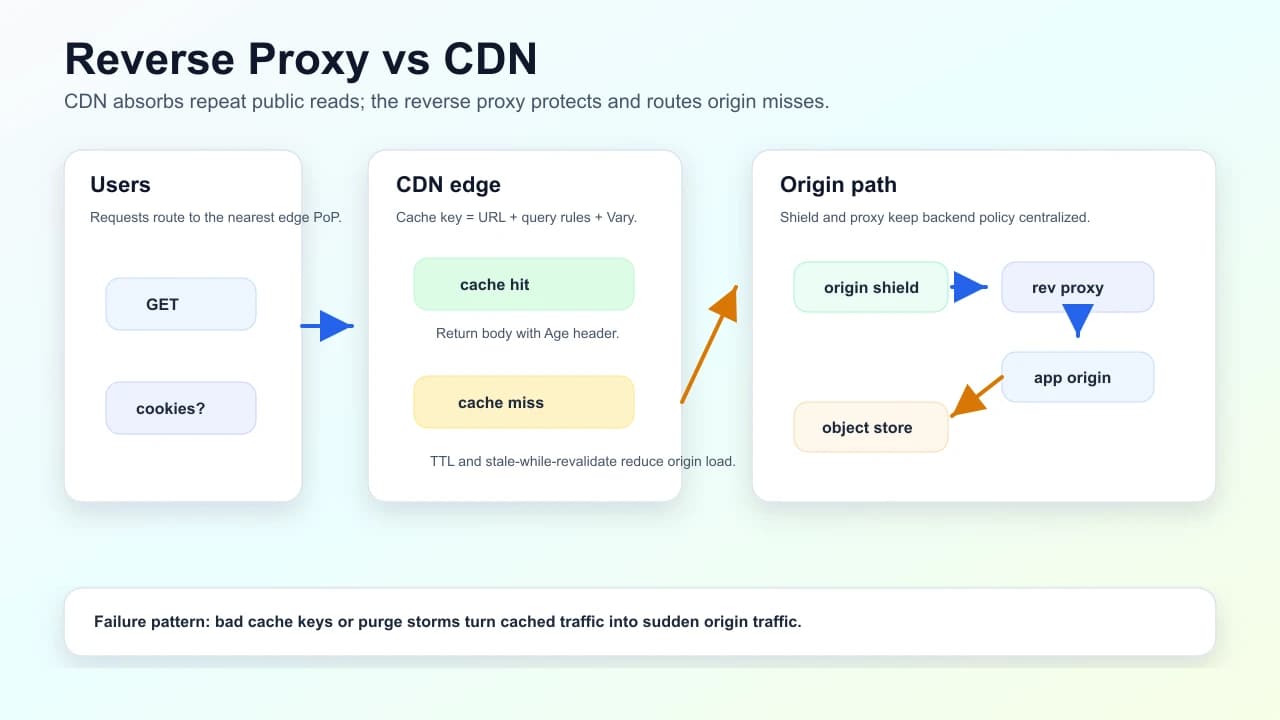
- Cache key typically includes: URL path, query string normalization rules,
Varyheaders (e.g.Accept-Encoding,Accept-Language), and sometimes custom headers for cache segmentation. - TTL (
Cache-Control,s-maxage,CDN-Cache-Control): shorter for HTML that changes often; longer for versioned static assets (/assets/app-v123.js). - Stale-while-revalidate: serve stale content while refreshing in background—better perceived latency.
  Client --GET--> CDN edge --miss--> Origin / reverse proxy --> App
                     |
                     +-- hit --> return cached body + Age header
Alternatives
- Direct to origin with no CDN: simpler, higher latency and load globally.
- Client-side caching (service workers, browser cache): complements CDN; does not replace edge for first visits.
- Application-level caching (Redis): for personalized or dynamic data; different layer than HTTP CDN.
Failure modes
- Stale content: long TTL after deploy; mitigate with cache busting (hashed filenames), purge APIs, or short
max-agefor HTML. - Wrong
Vary: serving gzip HTML to a client that cannot decode, or wrong language slice. - Cache poisoning: malicious query strings create unique keys; normalize keys and strip unsafe inputs.
- Origin overload on purge storms or thundering herd after expiry—coordinate with caching strategies.
Interview talking points
- Separate static (CDN-friendly) from dynamic (API, auth); cookies often prevent CDN cache for personalized pages.
- Mention shield/origin capacity: CDN absorbs spikes; still estimate origin with back-of-envelope for cache miss ratio.
- Tie edge latency to latency-throughput: fewer round trips to origin improves user-visible latency.
Related fundamentals
Mark this page when you finish learning it.
Last updated on
Spotted something unclear or wrong on this page?