Rate Limiter
What it is
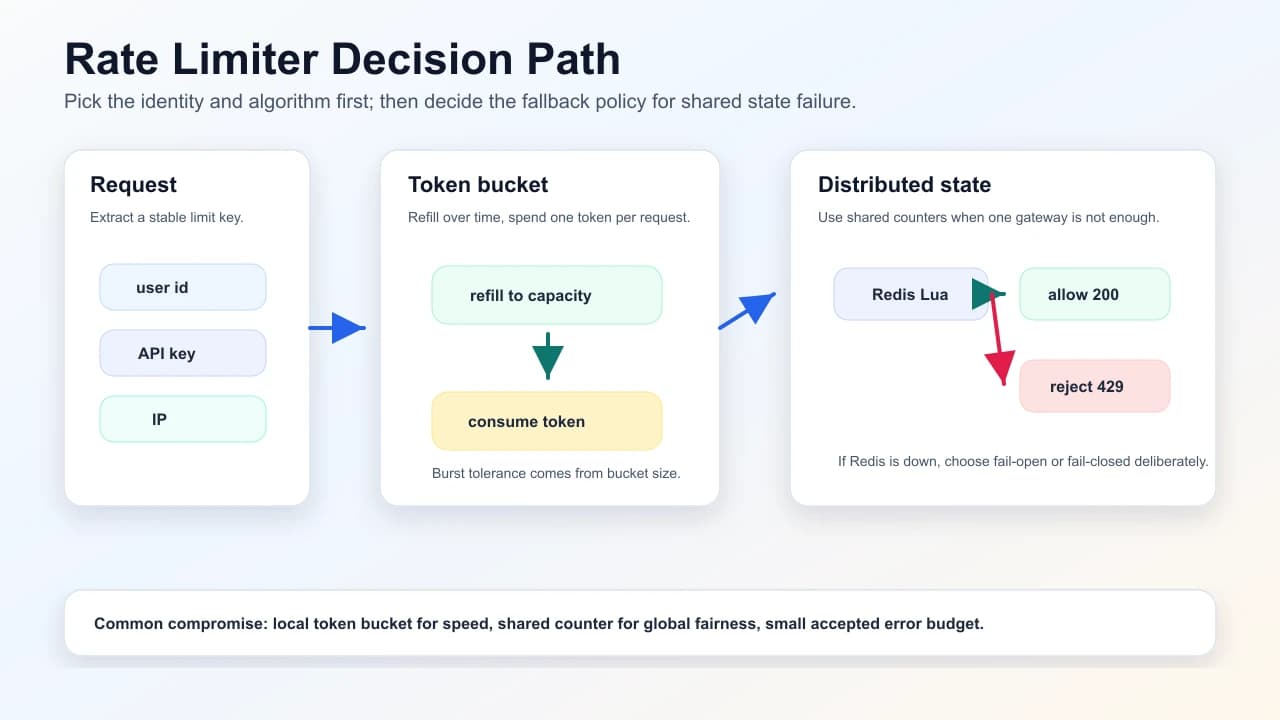
A rate limiter caps how many requests a client (user id, IP, API key) can make in a window to protect services and ensure fair usage. Algorithms differ in burst behavior and memory costs.
Algorithms
Token bucket
- Tokens refill at rate refillPerSecond up to capacity.
- Allows smooth bursts up to bucket size; common for APIs that tolerate short spikes.
Leaky bucket
- Requests enter a queue leaking at fixed rate; smoothes output to steady rate; can queue or drop when full.
Sliding window log
- Store timestamps of each request in a window; precise count; memory-heavy for high QPS (optimize with sliding window counter hybrids).
  Token bucket:   [tokens + refill] --allow--> forward request
  Leaky bucket:   queue --drip fixed rate--> steady downstream
Distributed approaches
- Central Redis (or similar):
INCRwith TTL, Lua scripts for atomicity, or Redis Cell-style modules. - Sticky routing: limit per gateway instance—inconsistent across nodes unless synchronized.
- Approximate counting (e.g. Gossip, probabilistic) for global scale—trade accuracy for cost.
Synchronization cost affects latency-throughput; local + async sync is a common compromise.
When to use
- Public APIs, login endpoints, expensive operations.
- Multi-tenant fairness and DDoS mitigation at application layer (with network-layer defenses).
Alternatives
- Admission control at load balancer (see load-balancer); coarser granularity.
- Back-pressure via queues instead of hard reject—different UX.
Failure modes
- Clock skew across nodes skews windows—use server time authority or tolerate fuzz.
- Redis down: fail-open (risky) vs fail-closed (availability hit)—document policy.
- Hot keys for global counters—shard limit keys or use local token buckets with small error.
Interview talking points
- State limit dimensions: per user, per IP, per endpoint, global vs regional.
- Choose algorithm by burst tolerance (token bucket) vs strict smoothness (leaky bucket).
- Estimate allowed QPS with back-of-envelope given fleet size.
Related fundamentals
Mark this page when you finish learning it.
Last updated on
Spotted something unclear or wrong on this page?